Sunday, August 2, 2020

Time Management is a Myth

In my 15+ years as a personal development and human potential coach, one of the common challenges of clients is finding the time to get the coaching work done. Most adults are very busy people. Adding an additional 5-10 hours of coaching work can be very difficult.

One idea I'd like to share often makes a huge difference as clients struggle to find the time needed to be effective in their coaching program and find the improvement and clarity they desire.


The idea is this: time management does NOT exist. At least the idea that we can manipulate time is not a reality.

True, some sporting events can “stop the clock” and call a time out. 

For real life, the clock keeps moving and time does not stand still.

When I consider the idea of “time management,” what really comes to mind is the process of prioritizing our activities. That we can do!

In my parent’s era when I was growing up, they used an envelope system to allocate the family income to the various expenses and obligations. If the money ran out of the “groceries” envelope, it meant there was no more food purchases that month, or some of the money from another envelope was reallocated to the grocery envelope to make ends meet. There was no putting it on the credit card and hoping to figure it out later. 

Therein lies the key to allocating our finite amount of time. We all have 24 hours in a day, 168 hours in a week. How we choose to use that time is our challenge and our opportunity.

Like the budget envelopes of my parents, we can allocate our 168 hours in advance into different activities and projects. We can reassess throughout the week our choices of priorities and adjust if needed.

One of the most powerful benefits of this advanced scheduling is our ability to honestly say “no” to others looking to get the use of some of our 168 hours. 

Because we have already allocated our 168 hours in advance, we now have the option of kindly explaining that we are currently unavailable to help because of a prior commitment. Or, we can decide to elevate their request to be a priority for us as well and say yes.

Personally, I resist detailed scheduling in advance as explained in the Myers-Briggs Type Indicator preference of “Perceiver.” However, when I’m faced with too many interruptions, or if I’m simply finding myself becoming less effective, I choose to schedule my 168 hours in detail so I have a ready option to say no, or yes, to the interruptions that come my way. 

The ability to say “no” is one of the very best ways to improve our productivity and get the things that are our highest priorities done on a regular basis.

For more information about my coaching programs and how you can increase your potential, email me at chris@dtesuccess.com or text me at 801-410-2266. Mention my "Do The Extraordinary" blog for special pricing.

Start now to live a life of vision and clarity, with a renewed sense of hope for your future, and get on your very own customized path to a life of joy and abundance in your very first coaching session!


Tuesday, May 26, 2020

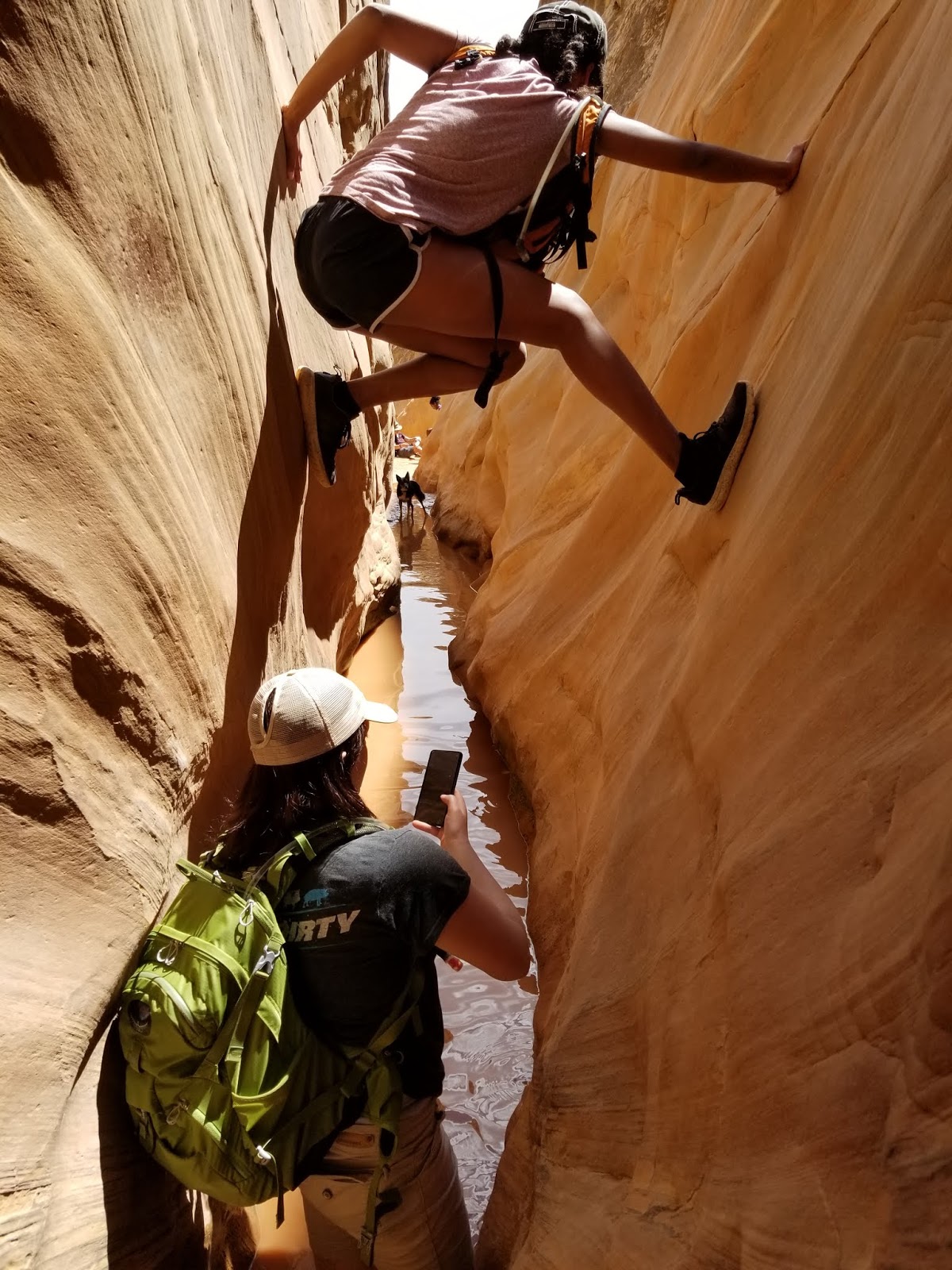
Ding and Dang Canyons - Goblin Valley Area, San Rafael Swell, UT


Ding and Dang Canyons are non-technical slots canyons west of the more popular Bell and Wildhorse Canyons near Goblin Valley State Park.
The trailhead is only about a mile west of the Wildhorse trailhead parking. Depending on road conditions, most vehicles can make the drive to Ding and Dang, but the road is much more rugged once you pass the Wildhorse parking area. 

I’ve never traveled this area in anything but a high clearance 4X4 vehicle and caution and care should be taken when driving in the backcountry in a regular passenger vehicle. 

All my posts are for informational purposes only and each person must accept their own responsibility for potential challenges associated with outdoor activities.

As a note: Within days of doing this hike, two children were killed in a flash flood in Wildhorse Canyon. Weather is a major factor in accessing the dangers of hiking the canyons in the desert southwest.

After parking at the Ding and Dang trailhead, the route follows the open canyon to the west until the drainages merge. To the left is Dang and to the right is Ding. 
I like to hike in a counter-clockwise direction as I find it easier to descend the higher drops of Dang Canyon and ascend the shorter climbs in Ding Canyon.

No matter what direction you choose to go, there are plenty of boulder chokes, climbs and descents to work through. This is a more technical hike than Wildhorse, and the BLM recommends being prepared with technical gear. We brought rope but ended up using the ropes already in place at each descent in Dang Canyon.
Plan on standing water in the canyons, especially in Dang Canyon. We managed to keep our feet dry until one of the last sections of Dang Canyon. If you are willing to shimmy your way through the wet sections, it’s often possible to stay dry. I didn’t want to work that hard and had planned on wet feet anyway.

When Ding Canyon starts to open up, pay attention to the pointed butte to the west called Ding Dang Dome. This is the direction to hike to access Dang Canyon for the return trip through the swell.
There is more than one trail as you work your way towards the butte and we chose to stay to the left (southwest direction) and found that this trail was shorter than the alternative that went right (northwest direction.)
Once past Ding Dang Dome the return canyon, Dang, comes into view. 

It doesn’t take long before longer and steeper drops become more common. In every case, rope or webbing was already placed at each drop, but it’s best to bring your own rope just in case.
Enough upper body strength to control your ascent for each drop is a must as the drops are significantly longer than those found in Ding Canyon. Hence, the preference to descend Dang Canyon.   
This is where the BLM recommending technical gear to make the descents safely.

The last major obstacle in Dang Canyon is the section with the highest probability of getting wet feet. It is narrow enough that someone shimmying could keep dry, but it is a long section to shimmy before the water is completely avoided.
Once the slot canyon opens up, it still takes some time and distance to reach the confluence with Ding Canyon and you reach the trailhead parking area.

Additional Photos:

Friday, January 17, 2020

Are You Open-Minded, Really?


I like to walk to disconnect from all the distractions around me and just think. I used to listen to music while I walked, but I found by not having any electronic distractions, I develop more original thoughts.

As I was walking a few weeks ago I started thinking about being open-minded and whether or not I was very open-minded personally.

I think over the years I have become less open-minded in many ways, and more open-minded in many ways, depending on the subject matter. 


 One idea that came to mind as I was pondering being open-minded was this thought.

Being open-minded means being willing to ask questions we don’t already know the answers to.

Our media sources are loaded with what appears to be “discussion groups” or interviews that are simply set up to only ask the questions that already have specific responses already decided and expected. 

Or if a contrarian view is presented, the haters pile on the hate and try and shout down the alternative point of view. 

Whenever you are faced with a point of view that you automatically disagree with consider if you are willing to ask questions to which you don’t already know the answer. 

Maybe you will recognize you need to develop a more open mind. 

(Photos: Dimple Dell County Park)